A trapped stye in the eye
Introduction to a stye in the eye
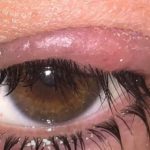
A stye in the eye is a localised inflammation situated in one (or more) of the small glands located in the eyelids and responsible for secreting the fatty substances needed for the formation of tears. These glands are called the meibomian glands. It is a very common disease in the field of eye and eyelid health. The stye usually presents like a red and swollen lump, similar to a pimple. There can be cases that present as acute pain sensitive to touch, and there can be cases with a more chronic course. Its prevalence is higher among patients with rosacea and patients with chronic eyelid inflammation (blepharitis), and further conditions that will be detailed below.
The meibomian glands are sebaceous glands which produce fatty secretions and are located in the area of the tarsal plate of the upper and lower eyelid. The fatty compound is a critical component in the production of the tears. In each eyelid there are about 20-25 glands, and the inflammation can occur in one or more glands at the same time. The stye can be external, when it involves the glands in the outer part of the upper or lower eyelid (called the glands of Moll and glands of Zeis) or involve the inner eyelid and the meibomian glands located in this area. (as can be seen in the illustration attached here)
The mechanism of development of the stye
If the opening of one of the glands on the eyelid margin becomes blocked, this causes the content of the glands to be secreted into the tarsus and the surrounding tissues. When there is a problem in the proper drainage of the gland, remnants of debris and tear components begin to accumulate, which subsequently causes an inflammatory response accompanied by swelling, redness and pain. There is usually also a component of bacterial infection which contributes to the development of the inflammation. When there is an accumulation of inflammatory components, debris and pus into a collection, an abscess with defined borders forms. The common bacteria involved in a stye are bacteria that are routinely common in the eyelid area such as staphylococcus aureus, but the mechanism of their contribution to the development of a stye in the eye is not fully known.
Histology of a trapped stye in the eye
In histological sections the tissue components can be seen under a microscope and thus the different cell types can be distinguished. By looking at the histology one can understand in depth the behaviour of the body in the various disease states. In this case it is an inflammation localised to the area of the meibomian glands in the eyelid. Histologically, when looking at a section taken from an inflamed meibomian gland, a stye in the eye is characterised by signs of chronic lipogranulomatous inflammation. That is, inflammation that involves fatty cells and also granulomatous cells which are components of the immune system, where the chronic part indicates that the inflammation develops over time. In addition, within the accumulation of cells one can find areas of necrosis, that is, areas of cells that have undergone cell death and necrosis has formed.

Common symptoms
The symptoms of a stye in the eye are varied, and can range from states that are asymptomatic (that is, the patient does not experience complaints of them) that pass on their own within a week or two usually, to a real disturbance in quality of life. The most common symptoms are:
• A red and swollen lump. Sometimes painful or causing a sensation of unpleasantness
• Swelling of the involved eyelid
• Discharge and pus in the area
• Watering
• A sensation of itching or a foreign body in the eye
• Sensitivity to light
• There may be rare complications such as drooping of an eyelid, spread of the infection, damage to the growth of lashes in the area, damage to the drainage of the tears
If symptoms of reduced vision or intense pain appear, medical help should be sought quickly and other conditions ruled out.
Examination at an ophthalmologist
When there is a stye that causes symptoms which affect daily functioning or that does not pass on its own, it is recommended to come for an examination at an ophthalmologist. The diagnosis of a stye in the eye is a diagnosis that is fundamentally clinical (that is, it is usually possible through medical questioning and through looking at the finding to diagnose that it is a stye) and does not require invasive tests. The examination will include medical questioning, an examination of visual acuity (in order to understand whether there is an effect on vision), and afterwards a comprehensive look through the slit-lamp device in order to understand the extent of the inflammation formed, whether the stye is internal or external. Further tests may be required in certain cases. After the comprehensive examination the doctor will decide what is the most correct course of action in order to treat the stye.
Risk factors for the development of a stye
A stye in the eye is a common problem in all sections of the population, although there are a number of conditions in which the likelihood of a stye developing is higher. People with a background of one or more of the following diseases: chronic eyelid inflammation, skin diseases such as dermatitis or rosacea, diabetes, high levels of cholesterol – have a higher increased risk of developing a stye. Likewise, people who have poor eye hygiene – such as not being careful to remove eye make-up or using old products, putting in or taking out contact lenses without disinfecting the hands, they too have an increased risk of developing a stye in the eye.
Is a stye in the eye contagious?
This is a question that occupies many people and in particular parents of children who present with a stye in the eye. There is a perception in the population that when a person has a stye one should keep a distance from him in order not to be infected. This assumption is incorrect. In most cases, a stye is not a contagious condition since it is an inflammation that is localised to the gland itself and does not infect through superficial contact. (similar to a pimple located on another area of the body, which develops by a similar mechanism and we do not keep a distance from people who have a pimple since it is not contagious). We will qualify and say that with intensive contact there can indeed be some transfer of bacteria and therefore hygiene and hand-washing before and after contact with the eye should be maintained, and also between contact with one eye and the other eye, but the likelihood that this contact will be contagious is low.
Prevention of a stye in the eye
Adherence to principles of prevention is important mainly in people who suffer from a stye that recurs several times in their lives, or in people who have chronic eyelid inflammation or additional risk factors. It is very important to adhere to the rules of prevention as far as possible since good and effective adherence greatly reduces the recurrence of the stye. The guiding principle in primary prevention is daily adherence to eyelid hygiene, by means of gentle cleaning with warm water and a dedicated soap. By adhering to washing of the hands before and after any contact with the eyes (including insertion of contact lenses). In certain cases one can buy dedicated disinfectant wipes and clean the eyelids with them. As for eye make-up – it is important to be careful to remove eye make-up completely before sleep, not to use the same make-up over more than a few months, not to share make-up products with other people.
Stye in the eye treatment
There are situations in which the stye does not cause severe inflammation and it passes on its own within a week or two usually without the need for further treatment. Even so, in any case of the appearance of swelling, redness and pain there is a recommendation to come for an examination at an ophthalmologist. In particular if the stye does not pass, or alternatively if the symptoms interfere with quality of life, one should turn to an ophthalmologist as soon as possible in order to receive an orderly diagnosis and afterwards to receive the most appropriate treatment.
The treatment of a stye in the eye is composed of several arms: self-treatment by the patient combining massage, warm compresses and hygiene; drug treatment; surgical/instrumental treatment. As a rule, one usually starts from the first arm of adherence to eyelid hygiene; if this is not enough one advances to local/systemic drug treatment or applies both these arms in parallel. And if these solutions do not provide the solution, more invasive alternatives can be considered, which we will refer to below.
Self-treatment at home – eyelid hygiene
In the acute inflammatory stage, the treatment is composed of massage by means of warm compresses and appropriate eyelid hygiene. The warm compress (a towel or gauze dipped in warm water) should be pressed to the eye with gentle circular movements, about ten minutes for 3-5 times a day. If there is a stye in both eyes, different compresses should be used for each eye. The compresses help to soften the gland and release the secretions that have accumulated in it. Eyelid hygiene can be done by cleaning with dedicated wipes. Pressing and applying pressure on the stye in order to burst it should be avoided. It is recommended to avoid using eye make-up as long as there is an inflamed stye, and of course to wash the hands before any contact with the eye area.
Into this part of home treatment also come grandmother's remedies of various kinds, which have existed for many years for the treatment of a stye. These are various substances to which anti-inflammatory and sometimes also antibacterial abilities have been attributed, but these have not been tried in extensive trials and are not supported by the medical literature. A common grandmother's remedy, for example, is the placing of a warm tea bag on the eye. The tea bag also serves as a compress that softens the secretions and helps to expel them, and likewise anti-inflammatory abilities have been attributed to tea that make it possible to weaken the inflammatory processes. Further detail can be seen in the entry "a stye in the eye – grandmother's remedies".
Drug treatment for a stye in the eye
Local antibiotic or anti-inflammatory medications, or medications containing a combination of the two above components, are the approaches to drug treatment of a stye in the eye. An acute secondary infection can be treated by means of an antibiotic intended for bacteria common on the skin (such as staph aureus). Common ointments are Maxitrol and Lotemax which contain steroids to reduce the inflammation. There are ointments containing antibiotics only such as Tobrex or synthomycin (chloramphenicol) and they too constitute a treatment for a stye. For further detail on this drug treatment one can consult the entry "a stye in the eye – synthomycin".
In cases of a stye that does not respond properly to these ointments or in more severe cases one can also add oral treatment (pills) such as doxycycline, tetracycline and azithromycin because these are medications that have an anti-inflammatory and antibacterial component and thus they help both in eradicating the bacteria that have accumulated and in calming the inflammation that has formed. Tetracyclines and azithromycin have been shown in studies done in vitro and in humans to regulate the expression of inflammatory mediators and further components that are harmful in inflammation. Even so, there is a contraindication to this treatment in children and in pregnant women. In addition, these are medications that require prolonged use that can lead to the development of allergy, distress in the digestive system, sensitivity to light, partial compliance and the development of resistant bacteria. Therefore, of course, their use is conditional on the approval of a doctor only.
Surgery for a stye in the eye
In situations of a chronic stye in the eye, or in cases in which the drug treatment is not enough in order to reach the optimal results, sometimes surgical intervention is required. It is a simple and relatively quick procedure carried out in a clinic setting under local anaesthesia with a quick recovery. In most cases, the greatest inflammatory response is in the back part of the eyelid (the tarsal conjunctiva) and an incision is required through the tarsal conjunctiva and the tarsus itself in order to carry out drainage of the secretions that have accumulated (that is, not directly through the skin but from the inner part). The actions that will be done in the surgery are: sharp dissection, curettage and excision of all the necrotic material, including the wall of the cyst. During the procedure it is important to be careful of damage to the eyelid margin or close to the area of the punctum – an area located in the medial part of each eyelid and responsible for the drainage of the tears from the eye. In rare cases, the inflammatory response is more severe in the front (external) eyelid; in these rare cases a skin incision is used. In cases of a stubborn stye in the eye that recurs in the same place, in the differential diagnosis there is also a rarer possibility of sebaceous cell carcinoma (a malignant process) and therefore in these situations it is advisable to send for histological diagnosis in order to confirm the diagnosis, since in a state of carcinoma or other pathology the approach to treatment is completely different.


Steroid injection
Injection of corticosteroids (intralesional corticosteroids) is a less invasive option than surgery. In this procedure an injection of steroids into the cyst in the gland is carried out, and thus it quickly reduces the inflammatory process and encourages healing. This injection can have a side effect of changes in the pigmentation of the skin and it is a less effective treatment than surgery. The combination of excision and steroid injection leads to full healing in 95% of cases.
Treatment of a trapped stye in the eye without surgery – IPL (Intense Pulsed Light)
Recently, a technology called Intense Pulsed Light was developed which uses non-coherent light at a wavelength of 500 to 1200nm in a broad spectrum which has been shown to be effective for the treatment of chronic blepharitis and a stye in the eye. IPL treatment has an anti-demodex effect; demodex is a parasite that contributes in a high percentage to the development of blepharitis cases. In addition, IPL has an anti-inflammatory, antibacterial and anti-telangiectatic effect, and thus treats the inflammatory component of the stye. Likewise, a further effect that IPL encourages is the growth of healthy cells. This treatment has been found effective also for cases of a chronic stye that has recurred despite previous drug and surgical treatments. The significant advantage of this treatment is that it does not involve the use of medications and does not involve an incision of the area. In the example below one can see pictures of the same patient before and 3 days after IPL treatment.


Gland expression as a preventive treatment
In addition to warm compresses and eyelid hygiene, a further action that can be carried out in order to prevent the development of a stye in the first place is carrying out expression of the meibomian glands on a regular basis. This is a treatment that can be carried out at a skilled ophthalmologist. During the visit, with the help of a special instrument, the fatty material that blocks these glands can be expressed and thus prevent the development of a chalazion and everything that follows from it. Gland expression can be repeated as needed every few weeks. This action is carried out with anaesthetic drops and thus there is minimal discomfort if at all. After the treatment it is advisable to give a mild anti-inflammatory drop for a few days. A video demonstrating expression of the glands in the eyelid:
Have a question about your eyes? Want a specialist opinion?