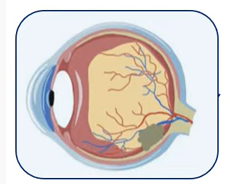
Retinoblastoma is the most common primary intraocular tumor in children and the second most common after uveal melanoma in adults. It occurs in 1 in about 15,000 births. The tumor occurs bilaterally in 30-40% of cases and equally between males and females. The tumor is detected in 90% of cases under the age of 3, and when there is a positive family history, on average in the fourth month of life.
Genetics
The disease results from a mutation in the RB1 gene, whose role is to suppress the development of the tumor together with other tumors. In order for the tumor to develop, damage to both copies of the gene is required.
 Only 5% of patients have a family history of retinoblastoma. A child of such a parent has a 50% chance of inheriting one copy of the defective gene, and then a 90% chance that it will manifest (a total of 45%). One normal gene is enough to suppress the development of the tumor, but this is a very unstable state, because a mutation in the normal gene may develop later on, and as a result the ability to suppress/prevent the development of the tumor is lost.
As noted, 95% of cases are sporadic. Two thirds of sporadic cases are unilateral and one third are bilateral. Of the unilateral cases, 85% are unifocal and without a germline mutation, but in 15% of the unilateral cases there is a germline mutation.
Non-carrier parents who have a child with bilateral disease sporadically have a 5% chance of having another child with expression of the disease, and when they have two such children there is already a 45% chance, since there is a high chance that they are carriers but have not been detected so far.
Diagnosis
The correct way to diagnose retinoblastoma is on the basis of the clinical signs. Only in rare cases, and by expertise alone, can taking a biopsy (fine needle aspiration) be considered, and there is always a danger of dispersing the tumor by the very act itself.
The most common clinical sign at a young age is leukocoria (60%), followed by strabismus (20%) and intraocular inflammation (5%). Other signs such as hyphema, heterochromia of the iris and so on are more rare. At a slightly older age (over the age of 5 years), leukocoria and a decline in visual acuity are the most common signs.
Differential diagnosis
The differential diagnosis of retinoblastoma includes: persistent fetal vasculature, retinopathy of prematurity, posterior cataract, coloboma, uveitis, toxocara granulomatosis, Coats disease, and more.
Classification
There are several classification and staging methods for retinoblastoma.
The Reese-Ellsworth classification — limited to intraocular retinoblastoma and catalogues the chance of preserving the eye when it is treated by external radiation alone.
International Classification System for Response to Chemotherapy — since today a very accepted treatment is chemotherapy, this classification was created, ranging between Group A (a tumor smaller than 3 mm and at a minimal distance from the fovea and disc) and Group E (without potential for visual acuity or with involvement of the anterior segment).
American Joint Committee on Cancer (AJCC) — TNM definitions.
International Retinoblastoma Staging System — a very common method clinically, which also grades according to intraocular involvement and extraocular involvement.
Retinocytoma
Clinically, retinoblastoma and retinocytoma cannot be distinguished (they can be distinguished histologically). Some experts regard retinocytoma as a benign variant of retinoblastoma.
Triretinal retinoblastoma
This refers to cases of bilateral retinoblastoma with additional intracranial involvement, usually in the area of the pineal gland, and it usually manifests years after the treatment of the retinoblastoma. It is possible that chemotherapy treatment has a prophylactic effect against this expression of the disease, because it is seen in lower percentages over time and as chemotherapy treatment gains momentum.
Treatment
As long as the disease is confined to the eye there is over 95% survival, compared with less than 50% when this malignant tumor spreads beyond the eye.
Enucleation
Enucleation is the definitive treatment for retinoblastoma. Indications for enucleation:
a. Involvement of over half of the globe
b. Involvement of the orbit or the optic nerve
c. Involvement of the anterior segment
d. Neovascular glaucoma
e. Poor visual acuity potential in the eye in question
The surgical technique tries to avoid perforation of the globe while trying to remove as much of the optic nerve as possible (over 10 mm).
Radiotherapy
External beam radiation therapy (EBRT) is an effective treatment because retinoblastoma is a very radiosensitive malignancy. There are several methods such as intensity-modulated radiation therapy, stereotactic radiation therapy and proton-beam radiation therapy, which are intended to lower the rate of side effects of the radiation (such as secondary tumors).
Brachytherapy
Brachytherapy with radioactive plaques is a very effective treatment for local tumors that do not respond to other treatments.
Cryotherapy
In this method a cryoprobe is used, applied to the sclera (the white) in the area of the tumor. This method is used mainly in combination with systemic chemotherapy and in tumors smaller than 4 optic disc diameters, and usually in anterior tumors.
Laser photoablation
Similar to cryotherapy, usually in combination with chemotherapy. In contrast to cryotherapy, usually in posterior tumors. In photocoagulation (argon laser) one usually aims at the area around the tumor. In contrast, in thermotherapy (diode laser) one aims at the surface of the tumor itself.
Chemotherapy
This is the treatment of choice in the last two decades, in that this treatment allows reduction of the tumor size and therefore it can be combined with the other treatments. In addition, it does not have the long-term side effects of radiation. The International Classification of Retinoblastoma best predicts the chance of "saving the eye".
It should be noted that this is the treatment of choice in patients with extraocular or metastatic involvement, and that some data show that it lowers the chances of trilateral retinoblastoma.
Chemotherapy can be administered systemically, into the ophthalmic artery, into the vitreous, and subconjunctivally.
Prognosis
Over 95% of patients in developed countries survive, with the most important risk factor being extraocular spread (usually through the optic nerve). Patients who survive bilateral retinoblastoma have a higher chance of additional secondary tumors.
Someone treated with radiation has a 25% chance of a secondary tumor, the most common being osteosarcoma (40% chance). For those patients who develop osteosarcoma, survival chances are around 50%.
Have a question about your eyes? Want a specialist opinion?