Key concepts about red eyes
– Taking a thorough history in a patient with red eyes is extremely important; it is important to identify the risk factors, the duration of the redness, and whether the redness is isolated to one eye or involves both eyes.
– Pain and vision loss in the context of a red eye are symptoms that can signal a more serious disease process.
– Acute or subacute causes are more likely to be associated with an identifiable cause. Chronic or recurrent red-eye diseases can pose a diagnostic challenge, and then it is sometimes harder to identify what the cause is.
– The first step in diagnosing a patient with a red eye should be identifying abnormal findings in and around the eye. Sometimes the problem can still be identified before the slit-lamp examination.
– Identifying distinctive ocular signs such as a follicular conjunctival reaction, purulent discharge or giant papillae can help in diagnosis.
Introduction to red eyes
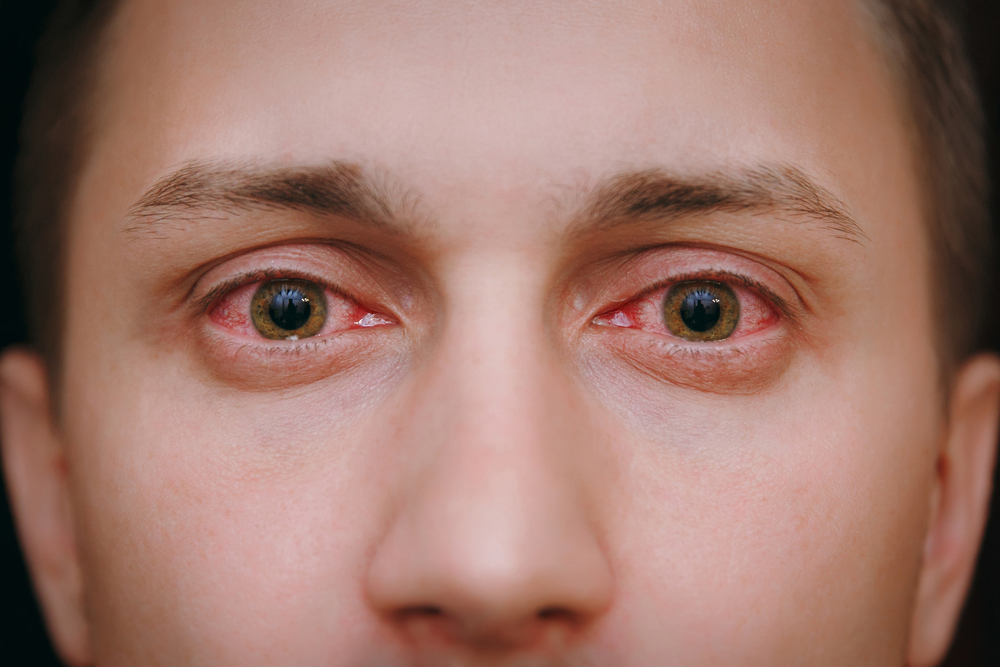
One of the most common eye complaints is a complaint of a "red eye". Unfortunately, red eyes are a particularly non-specific sign and may be associated with a wide variety of different diseases. As a single sign, it does not help distinguish between benign causes (for example, a subconjunctival hemorrhage) and a malignant cause that can endanger vision (for example, acute angle-closure glaucoma) or a life-threatening cause (for example, tumors in the posterior segment of the eye). The source of the red eye can arise from any of the structures in or around the orbit: the orbit, eyelids, cornea, conjunctiva, episclera, sclera or posterior segment. The red eye usually signifies a certain degree of inflammation in the eyes, although the etiology may be infectious, allergic, autoimmune or traumatic.
From the patient's point of view, red eyes, appearing as abnormal redness of the eyeball, the eyelids or the adjacent structures, signal that something is wrong. This can be cosmetically bothersome, especially in cases of chronic or recurrent red eye, but the redness may also be associated with other symptoms of pain or blurred vision that may add further worry or distress to the patient.
It is important to distinguish between common benign causes of a red eye and causes that endanger the patient's vision or life and require immediate intervention.
Identifying the risk factors
The first step in the approach to red eyes is identifying risk factors for certain diseases. An accurate history is no less important than a careful slit-lamp examination. For example… did someone in the surroundings suffer from red eyes? Was there a recent respiratory illness? Was there use of contact lenses? Contact with animals? Exposure to chemicals? Is there pain in other areas of the body such as joints? Is there a rash somewhere on the body? Are there infections or signs of an autoimmune disease elsewhere in the body? Was there recent eye surgery? Was there recent use of any eye drops, including homeopathic ones?
The onset and duration of the disease
Did the red eye appear recently, or has it lasted for some time? Are there recurrent episodes of red eyes, or is this the first time? Is it getting better or getting worse lately?
In general, acute causes are easier to identify. Examples include foreign bodies in the cornea or conjunctiva, corneal erosions, acute viral or bacterial conjunctivitis, and microbial keratitis of bacterial etiology. Some examples of intraocular conditions causing acute red eyes include acute angle-closure glaucoma and uveitis. Most of these acute and subacute conditions do not pose a significant diagnostic challenge; the cause is usually determined after an appropriate history and examination.
It is harder to diagnose chronic conditions (when it lasts more than several weeks) with recurrent episodes of red eyes. A careful history is important, especially when examined by several physicians who gave several different treatments over a long period. For example, a patient who underwent several eye surgeries and was left on several eye medications may complain of chronic redness, irritation and a foreign-body sensation. Many patients may also have systemic diseases such as thyroid disease, hypertension, diabetes, depression and seasonal allergies that may affect the ocular surface directly or indirectly as a result of medications used to treat the condition in question.
Unilateral or bilateral
It is not so important to know which eye is red (right or left), but it is more important to know whether the redness is unilateral or bilateral. If it is bilateral, did it appear in both eyes simultaneously or did it start in one and spread to the other? Or alternatively, does the redness alternate between the two eyes? Again, a careful history is the key to clarifying the underlying cause of the redness. For example, both eyes involved simultaneously and alternately may point toward disorders of the external ocular surface such as dry eye syndrome or chronic blepharitis (eyelid inflammation). An alternating red eye is more likely to occur with episcleritis or pingueculitis.
An example of the importance of the involved side is the red eye seen in patients with floppy eyelid syndrome. These patients may have a chronic unilateral red eye, and further questioning may reveal a preferred sleeping position on the side of the red eye. Due to the laxity of the eyelids, the eyelids inadvertently open during sleep and cause irritation to the external ocular surface.
Red eyes: pain
In addition to a thorough history of the current problem and the past medical and ocular history, two key symptoms can help clarify the severity of the disease and the urgency of evaluation and management. These key symptoms are the presence or absence of pain, and whether there is a change or loss of vision. For example, a subconjunctival hemorrhage should not hurt or cause vision loss. If the answer is positive to both questions, it directs us to a different problem.
Most causes of red eyes are associated with only mild to moderate irritation. Patients suffering from diseases of the external ocular surface such as dry eye and eyelid inflammation (blepharitis) will complain of mild burning, itching, irritation or a foreign-body sensation. Similarly, episcleritis, pinguecula and pterygia, and even small foreign bodies retained in the conjunctiva or cornea, should cause only mild to moderate discomfort. If a patient has moderate to severe pain or pain that often wakes them at night, a more serious etiology should be considered. Although severe pain often occurs with a simple corneal erosion (even a small one), it may also indicate more vision-threatening pathologies such as an infectious corneal ulcer, uveitis, scleritis and acute angle-closure glaucoma.
Vision loss
Vision loss is another important distinguishing symptom in addition to pain. Unlike pain, this symptom can also be confirmed through a visual-acuity test. If vision has been affected, the underlying etiology is likely one in which the cornea is involved (for example, a corneal ulcer or infiltrate), or an intraocular process causing secondary external inflammation (for example, iridocyclitis, endophthalmitis, acute angle-closure glaucoma). Conjunctivitis alone usually does not affect visual acuity. A decrease in visual acuity also helps indicate the severity of the underlying disease process. For example, punctate epithelial erosions are often seen in patients with dry eyes. In mild cases, visual acuity is likely not affected. However, for some patients with severe dry eyes, especially those with an underlying autoimmune etiology such as Sjögren's syndrome, diffuse punctate epithelial erosions can lead to a decrease in visual acuity.
News and articles on the topic of red eyes

Tired eyes
What are tired eyes? Tired eyes are a very common phenomenon among the population. As a rule, eye fatigue is caused by a demand on the visual system to focus for a prolonged time on a certain object under non-optimal environmental conditions. Accordingly, fatigue
Read more » March 4, 2023
Synthomycin 3% vs Synthomycin 5%
The antibiotic ointment Synthomycin has a variety of purposes and is often given to both children and adults. Chloramphenicol serves as the main active ingredient of Synthomycin. The antibiotic chloramphenicol is used to treat a variety
Read more » November 10, 2022 Synthomycin (chloramphenicol)
Synthomycin eye drops or ointment (chloramphenicol) — Synthomycin eye drops or ointment (the active ingredient is called chloramphenicol) are used to treat bacterial eye infections. In conjunctivitis the eye becomes inflamed and there may be a sensation
Read more » August 22, 2022Have a question about your eyes? Want a specialist opinion?