How Is Keratoconus Diagnosed?
I am often asked how an accurate diagnosis of keratoconus can be made. Well, the answer is that it is divided into several critical stages:
- The patient's complaints
- Medical/eye history
- Family history
- Habits and sleep habits
- Physical and ophthalmic examination
- Corneal mapping
- Changes over time
Keratoconus Diagnosis and the Patient's Complaints
In every patient with suspected keratoconus, it is important to ask several critical questions about their complaints. Have they experienced a decline in vision in the eyes with and without glasses? Did it happen in one eye more than the other, or symmetrically in both eyes? Was there a recent change in the glasses prescription? Does the patient snore at night (sometimes it is right to ask the spouse)? All of these can not only help in diagnosing keratoconus but also indicate progression of the disease.
Medical/Eye History and Keratoconus Diagnosis
Have they undergone laser vision-correction surgery in the past? Have they had any eye surgeries? Laser vision-correction surgery carries risks, and one of the rare ones is a weakening of the cornea that can lead to a picture resembling keratoconus (ectasia after LASIK). In addition, it is important to ask whether they suffer or have suffered from allergies or eye itching. People with eye allergies tend to rub their eyes, and today we know that this is a clear risk factor for keratoconus.
Family History in Patients With Keratoconus
Has anyone in the family been diagnosed with keratoconus? Has anyone in the family needed a corneal transplant? A family background of keratoconus does not require that all other family members will suffer from keratoconus at some point, but it is definitely a risk factor for the development of keratoconus and also for its progression. Therefore, in such patients there is a slightly greater tendency toward earlier treatment of the disease and closer monitoring.
Habits and Sleep Habits During Keratoconus Diagnosis
It is very important to ask about eye rubbing. Eye rubbing is the number one risk factor for the development of keratoconus and for the progression of the disease. If there is an allergy that causes the patient to tend to rub or scratch the eyes, then it is important to treat it in order to relieve them. If it is eye rubbing that stems from habits, then it is advisable to talk with the patient about it and find a solution. It is right to ask about sleep habits, especially in patients who are overweight and patients with very asymmetric keratoconus. We know today that there are patients who tend to sleep with the pillow pressed right against one eye (depending on their preferred side) and actually rub that eye during the night, and therefore more advanced keratoconus develops in that eye.
Physical and Eye Examination in Patients With Keratoconus
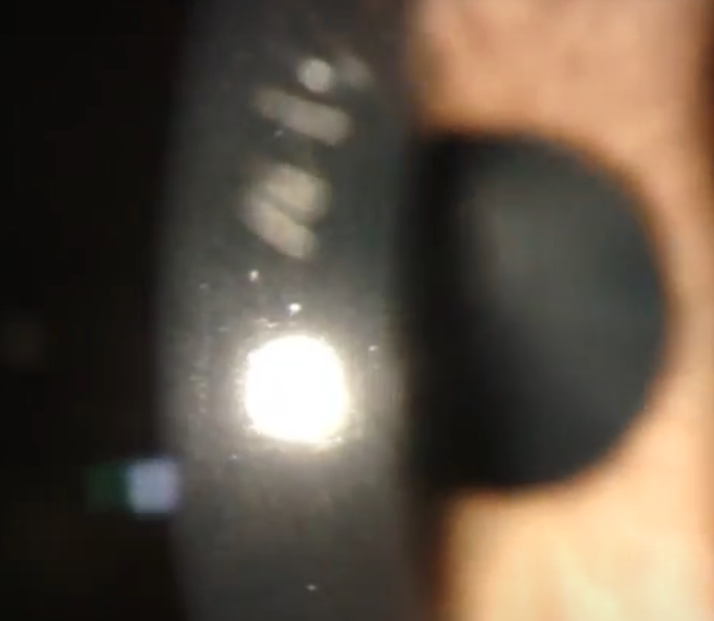
It is important to examine the patient from the moment they enter the room. Do they suffer from being overweight (nighttime sleep disturbances)? Are they very tall (Marfan)? Check visual acuity with and without glasses. Before examining the patient at the slit lamp, it is advisable to check whether their eyelids are especially lax (floppy eyelid syndrome), since it is known today that there is a connection between this and keratoconus. Then, in the examination itself, one can look for early signs of keratoconus such as a scissoring red reflex, the existence of an iron ring, vertical lines named after Vogt, and in advanced stages a scar in the cornea and Munson's sign.
Keratoconus Diagnosis Using Corneal Mapping
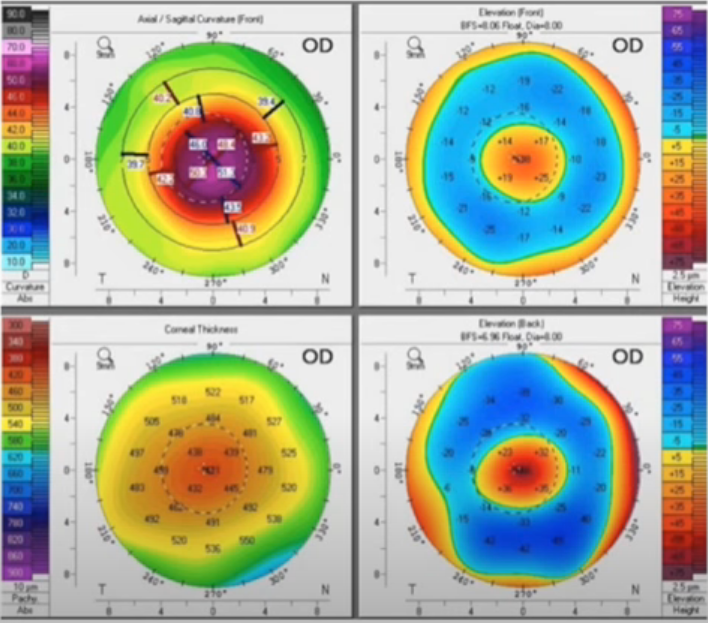
Corneal mapping, using multiple images, allows a reconstructed picture of the cornea to be obtained, which includes the curvature of the cornea, the thickness of the cornea, the anterior elevation, and the posterior elevation. Using all these parameters, it is possible to identify very precisely whether keratoconus exists, even in the very early stages of the disease. In addition, using corneal mapping it is possible to check over time whether there is progression of the disease before and after treatment of keratoconus.
Changes Over Time and Keratoconus
It is important to identify, also according to the patient's complaints, the eye and medical history, visual acuity, and corneal mapping, whether there are changes in the measurements. Changes in these measurements in a patient with keratoconus can indicate progression of the disease and indicate a need for treatment.
Have a question about your eyes? Want a specialist opinion?