Keratoconus usually affects both eyes and generally damages one eye more significantly. Most patients are in the age range between 10-25 years. Every visual impairment entitles the person to different disability percentages according to the degree and type of the impairment. So, for example, different situations such as damage to both eyes versus one eye, damage to half of the cornea or to all of it.
Keratoconus occurs when the cornea – the transparent, dome-shaped layer at the front of the eye – thins and changes its shape to a cone shape. A cornea in such a shape causes blurred vision and even sensitivity to light. Keratoconus usually affects both eyes and generally damages one eye more significantly. Most patients are in the age range between 10-25 years.

In the early stages of the disease, the visual impairment can be corrected by glasses or soft contact lenses. In more advanced stages, hard contact lenses or other types may be needed. If the condition persists and does not improve thanks to the external means, a corneal transplant may be needed.
Keratoconus in its advanced stages constitutes a visual impairment and is considered a chronic eye disease. Damage of this kind to vision limits the person affected by it and makes it difficult for them to carry out daily activities and even to earn a living. Accordingly, keratoconus patients are entitled to receive disability rights from the state and from the medical institutions. The National Insurance Institute is responsible for and entrusted with determining the degree of disability and its characteristics for keratoconus. The National Insurance Institute has clear parameters according to which the degree of disability and accordingly the disability percentages are determined, which are in keeping with the level of the visual impairment.
In most cases, entitlement to general disability is obtained at the National Insurance Institute after the issuance of the appropriate medical certificates. That is, it is necessary to provide various medical documents such as diagnoses, opinions of optometrists and ophthalmologists as needed, up-to-date vision tests and even special tests if such were carried out (such as, for example, corneal mapping) – in fact, it is advisable to attach to the application all the existing medical documents.
There are various entitlements and rights granted in respect of medical disability, also for those who are not found entitled to a disability allowance from the National Insurance Institute.
Keratoconus disability percentages
A medical committee for general disability will discuss the details of the patient and their state of health and will determine accordingly the degree of disability to which they are entitled and thus also their additional rights. This is because every visual impairment entitles the person to different disability percentages according to the degree and type of the impairment. So, for example, different situations such as damage to both eyes versus one eye, damage to half of the cornea or to all of it, ability to wear contact lenses or intolerance to contact lenses and so on, do not overlap in the aspect of the severity of the visual impairment.
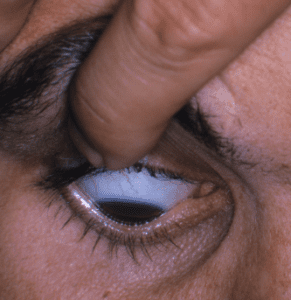
Among the benefits to which keratoconus patients are entitled, the National Insurance Institute offers a monthly allowance, reduced fees at banks, guidance towards employment, a disabled badge and more. Moreover, the health funds too participate in various forms in the treatment of keratoconus. So, for example, at the health funds "Maccabi" and "Clalit" there is a discount on the purchase of contact lenses. That is, there are various entitlements and rights granted in respect of medical disability, also for those who are not found entitled to a disability allowance from the National Insurance Institute.
From the above, keratoconus is a medical condition that causes visual damage that deteriorates over time. Accordingly, it is possible to receive assistance and support from the various state institutions in order to cope with the visual impairment. The degree of assistance and entitlement to various rights are determined by the National Insurance Institute and by an appropriate medical committee.
Have a question about your eyes? Want a specialist opinion?