Every surgery in medicine, including in ophthalmology, has possible complications. Cataract surgery complications can occur as well. For most patients, cataract surgery is a simple surgery without complications, with quick recovery and a marked, rapid improvement in vision. But as with any procedure, complications are possible, especially if there are prior eye problems or a serious medical condition.
Failed Cataract Surgery
The success rate of cataract surgery is very high and stands at about 99%. In certain cases cataract surgery is not effective and the patient continues to suffer from vision disturbances or even a worsening of the existing condition after surgery. This is a rare situation, but patients who have additional underlying eye problems such as glaucoma or macular degeneration are at increased risk. When possible, it is advisable to evaluate and treat these problems before deciding to undergo cataract surgery. This is an irreversible surgery, since the cloudy lens is removed from the eye and cannot be put back.
Side Effects After Cataract Surgery
Glare: This is a common and normal side effect after cataract surgery; sunglasses help during the period when the eyes are sensitive. But if the glare continues beyond a few days, you should see the doctor to make sure it is not a complication such as eye inflammation or retinal detachment.
Pain: Pain is an expected complication of most surgeries. Since cataract surgery involves only superficial layers of the eye, over-the-counter painkillers are usually sufficient. If the pain persists or worsens, you should see the ophthalmologist, as it may be a sign of a more serious complication.
Dry eye or itchy eye: During the tissue healing process, sensations of dryness and itching are common. Lubricating eye drops may help.
Floating bodies (floaters): These are particles made of protein or collagen that cross the field of vision and cast shadows that interfere with vision. They usually do not require treatment and resolve on their own, but they can indicate other complications and therefore require a doctor's examination if they appear.
Worrying Cataract Surgery Complications
Infection: Most surgeries carry a certain risk of infection from surgical instruments, the surgeon's technique, or wound care after surgery. Endophthalmitis is an infection that can appear after cataract surgery, but it rarely happens — less than 0.5% of cataract surgeries. The patient may suffer from light sensitivity, pain, redness, and blurred vision, and it is necessary to see the ophthalmologist for antibiotic treatment.
Macular edema: This is the most common complication after cataract surgery and appears up to 8 weeks afterward. Sometimes after surgery blood vessels in the retina leak, and the fluid that accumulates in the eye causes blurred vision. Treatment involves steroid drops and lasts weeks to months.
Retinal detachment: The retina is a layer at the back of the eye that senses light (through receptors) and converts it into a signal to the brain. After surgery there is a small increase in the chance that the retina will be pulled and detach from the back of the eye, which is called retinal detachment. The patient will describe a sensation of a curtain falling over part of the eye, new floating spots in the field of vision, and flashes of light. This is an emergency that, if not treated in time, may lead to vision loss. It is therefore important to recognize the signs and, if there is suspicion, to urgently see the ophthalmologist.
Lens fragments: When removing the cloudy lens, particles of it may be released and remain inside the eye. When these are small particles they do not pose a problem, but larger particles can harm vision.
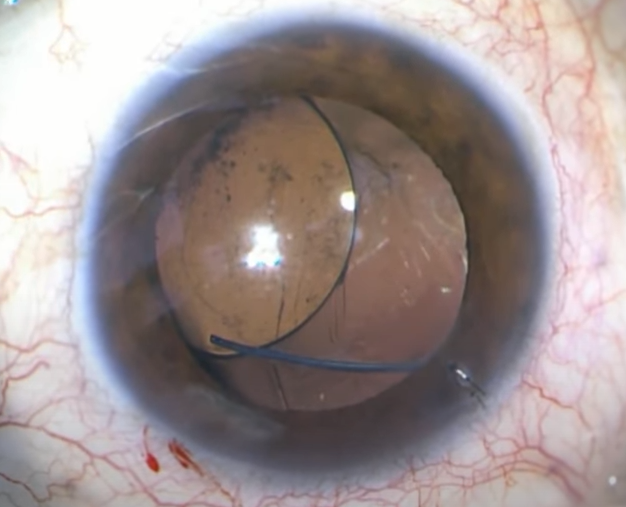
Displacement of the intraocular lens (IOL): This refers to the artificial lens that was inserted during surgery. The lens can slip out of place, which will cause blurred or double vision and even more serious complications such as bleeding and swelling. Surgery may be needed to return the lens to its place or replace it with a new lens.
Bleeding: Bleeding can occur mainly in patients with diabetes, high blood pressure, and various medical conditions after cataract surgery. This complication is rare but requires immediate treatment.
Iris prolapse: In rare cases, surgery may cause trauma to the iris and lead to prolapse. Sometimes this is related to poor wound closure or the healing process in the incision area, or to a prolonged period of increased intraocular pressure. The iris may return to its place, but in extreme cases corrective surgery may be required.
Common, Treatable or Transient Cataract Surgery Complications
Secondary cataract: There is a capsule surrounding the eye's lens, and during cataract surgery the artificial lens is placed inside the natural capsule. At the back of the capsule, a secondary cataract may form, which is a layer of cells that prevents light rays from reaching the retina, as occurs in a primary cataract — except that there it is caused by the lens itself being cloudy. If this complication occurs, a cataract-free opening can be created in the capsule using a YAG laser.
Increase in intraocular pressure: About half of the patients who undergo cataract surgery will experience some increase in intraocular pressure, but the pressure usually returns to normal within 24 hours. Ongoing problems of increased or decreased eye pressure after surgery may be related to eye diseases that preceded the surgery, such as glaucoma.
Corneal edema: The cornea is the transparent part at the front of the eye. It may be swollen and hazy after surgery, which will make vision difficult. This can happen anywhere after surgery but usually appears at the points where the incisions were made. The problem almost always resolves within days to weeks, and it can be treated with topical steroids to reduce the swelling. In rare cases, chronic corneal edema remains.
Have a question about your eyes? Want a specialist opinion?