The eye is a complex sensory organ, made up of several interconnected structures that work in harmony to capture and process visual information.
The human eye is an extraordinary organ that gives us the special ability to perceive the world around us. From the vibrant colors of a sunset to the intricate details of a delicate flower, our eyes are the gateway to experiencing the beauty and complexity of our environment. Here we will delve into the fascinating anatomy of the eye, its intricate structure, and understand how our eyes work to provide us with vision.
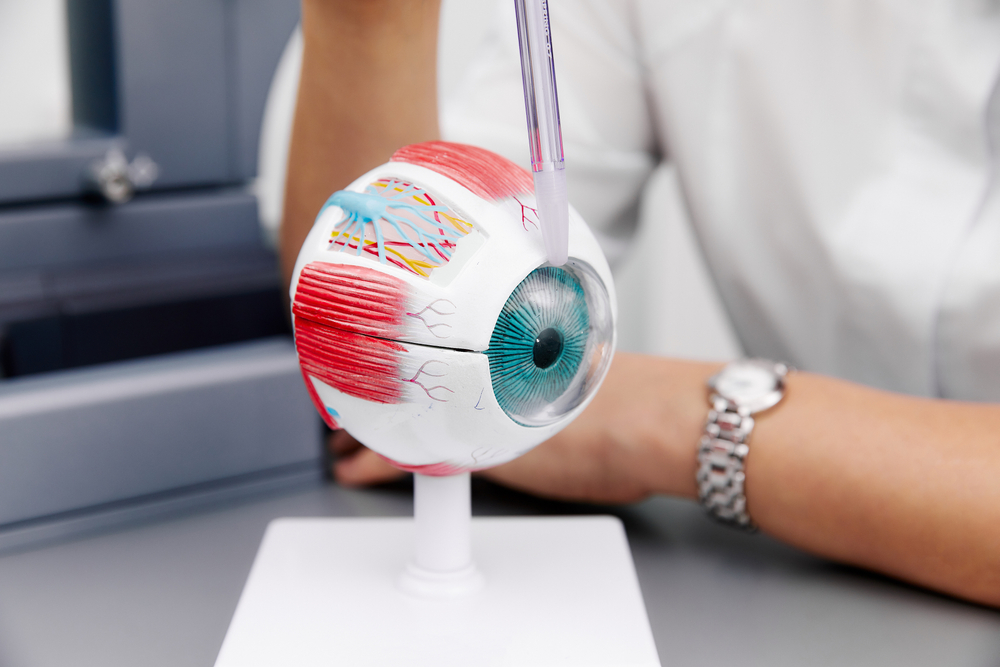
Anatomy of the eye, structure of the human eye and its function
The eye is a complex sensory organ, made up of several interconnected structures that work in harmony to capture and process visual information. These are the main parts of the eye:
1 – Cornea: the cornea is the transparent, dome-shaped front surface of the eye. It acts as a protective barrier and helps focus light onto the lens.
2 – Iris: the colored part of the eye, the iris, controls the size of the pupil – a small opening in the center of the eye. The pupil regulates the amount of light entering the eye.
3 – Lens: located behind the iris, the lens further focuses the light onto the retina. It adjusts its shape to allow us to see objects at varying distances – this process is called accommodation.
4 – Retina: the retina is the innermost layer of the eye. It contains specialized cells called photoreceptors, which detect light and convert it into electrical signals.
5 – Optic nerve: the optic nerve transmits the electrical signals from the retina to the brain, where they are interpreted as visual information. This is how we "see" the world around us.
The process of vision
By understanding the process by which the eye processes visual information, one can appreciate the complexity and wonder of this organ:
1 – Entry of light: when light enters the eye, it passes through the cornea and through the pupil. The iris adjusts the size of the pupil to control the amount of light entering.
2 – Focusing: the lens of the eye changes its shape to further focus the light entering the retina. This process allows us to focus on objects at varying distances.
3 – Reception: the retina contains two types of photoreceptor cells – rods and cones. Rods are responsible for peripheral vision along with low illumination, while cones perceive colors and work best in well-lit conditions.
4 – Signal conversion: when light hits the photoreceptors, they convert the light energy into electrical signals. These signals are then transmitted through the optic nerve to the brain.
5 – Brain interpretation: the brain receives these electrical signals and processes them into the images we perceive. It combines input from both eyes to create our three-dimensional visual experience.
Summary
The human eye is a masterpiece of evolution, allowing us to see the beauty and complexity of the world around us. The intricate anatomy of this organ, from the cornea to the retina, works together seamlessly to provide us with vision.
The process of vision involves an extraordinary collaboration of light, lenses and neural pathways, carrying information from the external environment to the brain. So, the next time you look at a breathtaking view, remember to appreciate the gift of vision and the complexity of the human eye that enables the structure of the eye and its function.
Have a question about your eyes? Want a specialist opinion?