Lens types in cataract surgery
The subject of lens types in cataract surgery has become a very active one in recent years. There are many types of lens that can be implanted during cataract surgery. Thanks to developments and innovations in eye surgery techniques and in intraocular lens (IOL) technology, it is now possible to remove the cataract — the clouded natural lens of the eye — and implant a new artificial lens in its place that corrects vision. The lens, together with the cornea, provides the focusing power for light rays; without it vision would be extremely blurred. When choosing which lens to implant, a number of factors have to be taken into account, among them what activities the patient carries out day to day and what kind of vision they need in order to do them.
Implanting different lens types in cataract surgery
During cataract surgery the eye's natural lens is removed and replaced with an artificial lens. This lens replacement is permanent and irreversible, and a cataract cannot form on the artificial lens, so there is no need to replace it in the future. There is a different complication, called a secondary cataract, but it is important to stress that this is not a clouding of the lens itself but of a layer of cells coating the back of the lens capsule. Repeat cataract surgery is therefore not needed — only the use of a laser in the clinic.
Like other synthetic implants, artificial lenses are made of acrylic, silicone or various types of plastic. These are inert materials that do not provoke an immune reaction from the eye against them. The lenses are coated with a special material that protects the eyes from harmful ultraviolet (UV) light.
Lens types: today there is a wide range of intraocular lenses (IOLs). The lens has to be matched to the patient on the basis of several factors, among them lifestyle and visual needs.
Monofocal lens
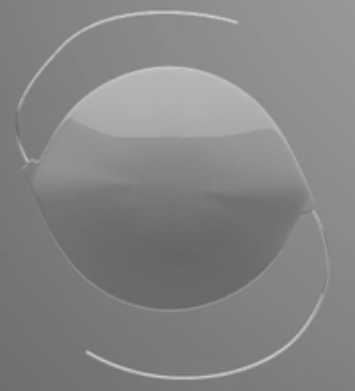 The most common type of lens. It is called monofocal because the focus is set for a single distance — near vision, intermediate distance or distance vision. Most patients choose to have vision focused for distance, which allows driving, walking and recognising people from afar without glasses, but glasses will be needed in order to read or carry out other close-up tasks. In dim lighting the quality of vision with a monofocal lens is reduced, and if this is an important consideration, using a multifocal lens should be considered.
Multifocal lens
 A premium multifocal lens that provides both distance vision and, at the same time, focus for near. This lens has different zones defined by different focusing powers. The multifocal lens splits the light between distance and near vision, which causes a reduction in contrast. Because of their particular optics, these lenses are not suitable for all patients but only for a small proportion of them. They are especially suitable for people who did not need distance glasses before surgery, or who were only slightly short-sighted with minimal astigmatism.
Multifocal lenses are not suitable for patients who are short-sighted or have significant astigmatism, and in addition they will not be recommended for patients who suffer from other eye diseases (such as glaucoma, diabetic retinopathy, macular degeneration and others) or who are at high risk of developing these eye diseases. As noted, these lenses do not provide very precise vision because the light is split between the different distances, and if the patient wants to make out fine detail they may not be the right solution. After implantation, haloes or glare around lights may be noticed, especially when driving at night. This is of course a subjective complaint, and many patients will not notice it at all or will be only minimally bothered by it. Even so, it is important to know about this phenomenon and to be aware of it, since patients who are very troubled by it can end up having the multifocal lens exchanged in a further operation, which raises the expected risks and complications.
Toric lenses
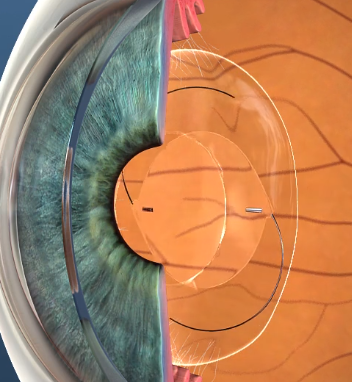 Premium lenses designed to correct astigmatism in addition to short-sightedness or long-sightedness. Astigmatism is a condition in which the cornea of the eye is not symmetrically curved across all of its parts, so that the eye's focusing power differs in different directions. The toric lens corrects astigmatism because it too, like the astigmatic eye, has different powers in different directions, which balance out the astigmatism and are individually matched for the correction required.
Monovision — two identical lens types in cataract surgery, set differently
Monovision is an arrangement in which one eye is implanted with a monofocal intraocular lens set for distance vision, and the other eye (the non-dominant eye) is implanted with a monofocal lens set for near vision. The brain adapts and combines the information received from both eyes to produce the final image. This technique is widely used in cataract surgery and succeeds in reducing the patient's dependence on distance and reading glasses after surgery, which significantly improves the way of life of many patients. Even so, glasses may still be needed at times for a sharper image. This option is not ideal for every patient, and some will not manage to adapt to the differences between the eyes. The recommendation is to try monovision with contact lenses before surgery, in order to simulate the situation and see whether you adapt to it and enjoy its advantages.
Have a question about your eyes? Want a specialist opinion?